When Does Apparel Make Sense for a Brand?

At some point, almost every successful hard goods, outdoor, or sports brand asks the same question:
“We want to do apparel. Should we?”
It’s a fair question. Seems easy enough. The logic is basic to understand. These brands already have an audience. They already have a use case. In many cases, they already have a lifestyle built around the product.
A fishing brand thinks about performance shirts. A footwear brand starts looking at outerwear. A golf equipment company wants to build a broader lifestyle assortment.
Sometimes that move works. Other times, it becomes a rack of logo hoodies and hats nobody really asked for.
The difference usually comes down to one thing: Apparel works when it delivers on the brand promise. It fails when it simply borrows the logo.
That is the distinction too many brands miss.
Why Brands Want To Move Into Apparel
Apparel is attractive for obvious reasons. It can increase purchase frequency, expand retail presence, create seasonal newness, and give consumers more ways to participate in the brand.
A hard goods purchase may happen once every few years. Apparel can create touchpoints every season. That’s why the idea is tempting.
But a bigger assortment does not automatically mean a stronger brand. Sometimes it creates the opposite. More noise. More inventory. More confusion. More pressure on a team that may not fully understand the apparel business yet. That’s where brands need to slow down and ask a better question.
Not “Can we make apparel?”
Most brands can. The better question is:
“Do we have consumer permission to make apparel people will actually want to wear?”
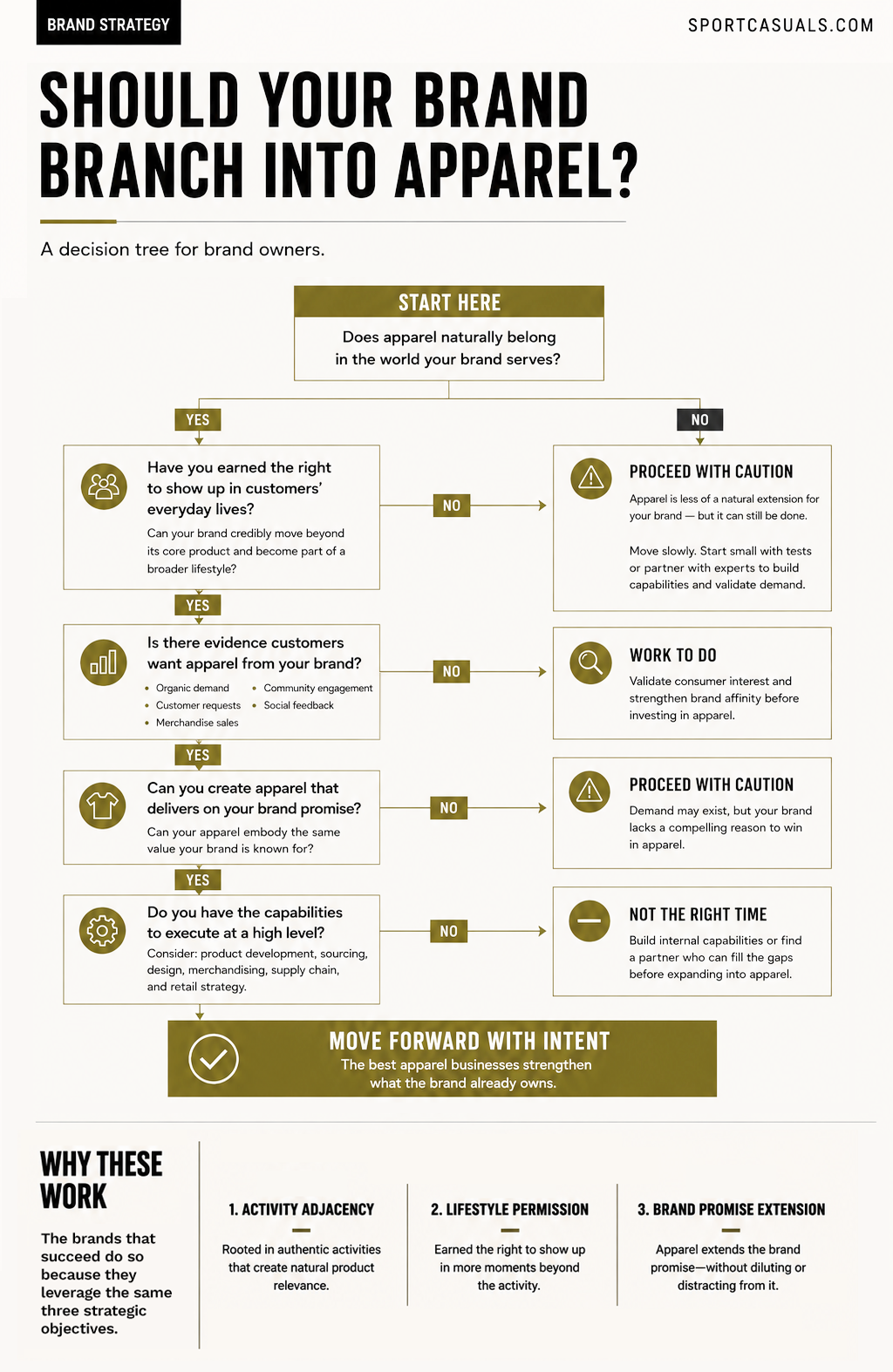
Awareness Is Not Permission
A brand can have awareness, loyalty, and even a strong following without having permission to move into apparel. That part is uncomfortable, but true.
Consumers may trust you for a fishing rod, a ski, a bike, a racket, a golf club, or a piece of equipment. That does not automatically mean they want you in their closet.
Permission has to be earned.
It usually comes from a mix of performance credibility, real usage, cultural relevance, and a clear point of view. The apparel has to feel like it belongs inside the world the brand already owns.
That’s why some footwear, outdoor, and sport brands make the jump naturally. The apparel supports the same activity, conditions, and identity that made the core product relevant in the first place. They are wearable proof of the brand promise.
Where Brands Usually Go Wrong
Most apparel failures follow the same patterns.
They mistake merch for an apparel business
There’s nothing wrong with branded hoodies, tees, or hats. Merch has a place. But merch and apparel are not the same thing.
Merchandise supports awareness and community. Apparel needs to support an actual product proposition. Those are very different expectations.
They launch too broad too early
A lot of brands skip directly to building “collections” before they’ve identified what role apparel should play inside the business. The result becomes unfocused assortments with no real point of view.
The smarter brands usually start narrow. One category. One occasion. One specific consumer need. Then they earn the right to expand.
They design for the logo instead of the use case
This is where a lot of programs get exposed. A logo can create initial interest. It cannot carry a weak product.
In sports and outdoor, apparel has to solve for something real: weather, movement, layering, comfort, durability, travel, fit, storage, versatility, or everyday wearability.
If the product does not work without the logo, the strategy is probably thin.
They underestimate the category
Apparel is not an accessory business. It is its own discipline.
The moment a hard goods brand enters apparel, it is no longer competing only against adjacent brands. It is competing against companies that live in fabric, fit, forecasting, merchandising, sourcing, margin, and seasonal storytelling every day. That changes the standard immediately.
When Apparel Actually Makes Sense

In our experience, apparel tends to work best when a few conditions are already true.
The brand owns a real lifestyle or behavior
Not an aspirational marketing identity. A real one. The strongest brands already represent a way of living, participating, or identifying.
Apparel becomes another expression of that.
The core product naturally creates outfit adjacency
This is especially true in outdoor and sports.
If consumers are already building an experience around the core product, apparel can become a logical extension of that ecosystem.
A trail running shoe naturally connects to shorts, shells, socks, packs, and layering. A ski or snowboard brand naturally connects to insulation, outerwear, fleece, and après pieces. A golf brand naturally connects to polos, pullovers, pants, rain gear, and off-course staples.
The outfit is already part of the activity. The brand just has to earn its place in it.
The apparel supports the hero product instead of distracting from it
This is critical. Good apparel programs increase the perceived value of the core business. They don’t dilute it. The apparel should make the hero product more believable, not less.
The brand can articulate a promise beyond logos
This is the big one. If the entire apparel strategy can be summarized as “people like our logo,” the ceiling is probably low.
The brands that succeed stand for something deeper that apparel can help express.
A Better Way To Think About Apparel Expansion
The smartest brands don’t ask: “How do we get into apparel?” They ask: “What role should apparel play in our brand ecosystem?”
Sometimes apparel should drive revenue. Sometimes it should support retail presentation. Sometimes it exists to deepen loyalty. Think first.
What We’ve Learned
Our experience has shown us that one thing has become very clear: The brands that succeed in apparel treat it as a continuation of the brand promise.
When the strategy is right, apparel can deepen identity, increase relevance, strengthen consumer connection, and create new commercial opportunities.
And when the strategy isn’t right? The market usually figures it out quickly.
The brands that win in apparel understand their role before they build the assortment. They know what problem they are solving, what identity they are reinforcing, and why consumers would choose them over brands that specialize in apparel full time.
That level of clarity is usually the difference between meaningful expansion and expensive distraction.
Considering an Apparel Expansion?
Apparel can be a powerful growth driver, but only when it aligns with the role your brand already owns in market.
SCI and Badge Design Studio work with brands across outdoor, sporting goods, team sports, and lifestyle categories to evaluate opportunities, develop product strategies, and bring apparel programs to market.
Contact us here to discuss your brand's apparel opportunity.